


Is Mera Peak Difficult for Beginners? An Honest Guide for First-Time Climbers
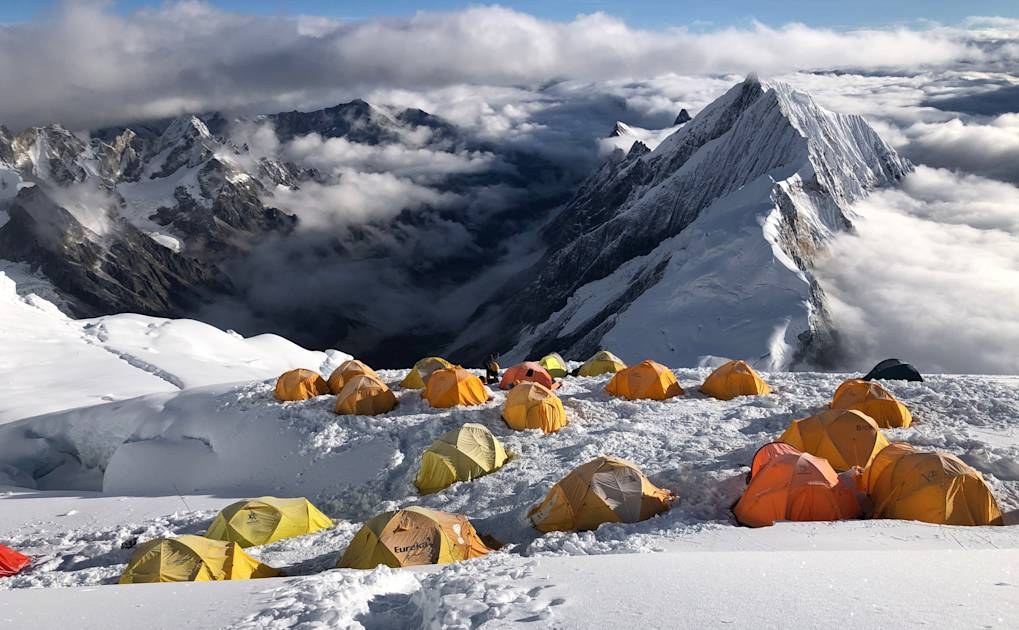
Table of Contents
The Short Answer: Technically Easy, Physically Demanding
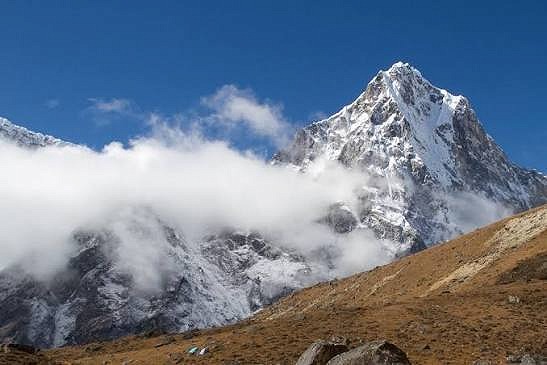
Mera Peak is one of the most popular first Himalayan summits for a good reason. The climbing itself is straightforward: wide glacier slopes, a roped team and one short steeper section near the top. What makes it hard is not skill but altitude, cold and endurance. At 6,476 m, it is Nepal's highest officially designated trekking peak, and summit day is a long, freezing push that starts around 2 am.
So is Mera Peak difficult for beginners? It is challenging, but achievable for a fit, well-prepared beginner with a guided team. You do not need prior mountaineering experience. You do need strong fitness, some high-altitude trekking background, a willingness to learn basic crampon and rope skills and plenty of patience with the altitude.
This guide explains exactly what is easy, what is hard and how to prepare, based on Unique Sherpa Trek & Expedition's 14-day Mera Peak Climbing itinerary.
Mera Peak at a Glance
| Detail | Information |
|---|---|
| Summit elevation | 6,476 m (Mera North); most trips climb Mera Central, 6,461 m |
| Region | Hinku Valley, eastern Nepal |
| Classification | Nepal trekking peak |
| Alpine grade | PD (peu difficile, "moderately difficult") |
| Itinerary | 14 days, Kathmandu to Kathmandu |
| Acclimatization and training day | Khare (about 5,050 m) |
| High Camp | About 5,780 m |
| Summit day | Roughly 8–10 hours |
| Best seasons | March–May and September–November |
| Price | From US$2,000 per person (group rates from US$1,950) |
Mera has three summits: Mera North (6,476 m), Mera Central (6,461 m) and Mera South (6,065 m). Mera Central is the one most commonly climbed, and it is the objective described in Unique Sherpa Trek's itinerary.
Why Mera Peak Is Good for Beginners
- Low technical difficulty. The standard route is mostly glacier walking, and slopes are often described as around 30–40°.
- No headwall. Unlike Island Peak, there is no long, steep rock-and-ice face to climb. One guide describes Mera as feeling more like a high-altitude trek than a climb.
- A built-in skills day. Pre-climb training at Khare covers harnesses, knots, belaying, rappelling, crampons and ice axe use before the climb.
- A gradual approach. The Hinku Valley approach takes about a week and builds acclimatization before high camp.
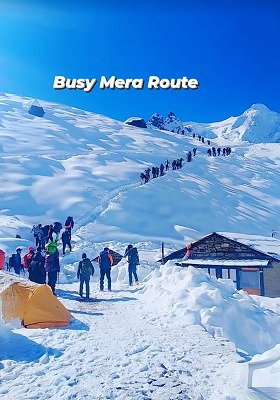
- Quiet trails. It is much less crowded than the Everest Base Camp route.
- Views. Five 8,000 m peaks are visible: Everest, Lhotse, Makalu, Cho Oyu and Kangchenjunga.
- A good stepping stone. Many climbers use it as their first 6,000 m peak before attempting harder objectives.
Mera was once graded as a simple "F" climb, but it was upgraded to PD because of changing glacier conditions and a short steeper dome near the summit. A fixed-rope section has been added in recent years because of shifting crevasses.
What Makes Mera Peak Hard
1. Altitude
You sleep at about 5,057 m at Khare and 5,780 m at High Camp, which is higher than the summit of any mountain in Europe. Oxygen is thin, sleep is poor and every step is slower. Altitude is the main reason people turn back on Mera, not technical skill.
2. Summit day
You leave High Camp around 2 am, rope up and walk across the Mera Glacier by headlamp. Most itineraries put the summit at around 9–10 am, with 8–10 hours total (other operators report 10–14 hours depending on pace and conditions). The last 40–50 m are the steepest, and Unique Sherpa Trek's itinerary uses fixed rope and jumars on this final section. Temperatures can be extremely cold, and wind makes it worse.
3. A remote, strenuous approach
Before you ever reach the glacier, you cross Zatrwa La (4,605 m) from Lukla, a tough 6–7 hour day, then spend several days in the Hinku Valley with no major villages. The descent includes more long walking days and a second crossing of Zatrwa La.
4. Cold and basic conditions
Nights at Khare and High Camp are freezing. High Camp is a tent camp, so you need a proper four-season sleeping bag and warm layers.
5. Weather
Himalayan weather changes quickly. Strong wind, snow or poor visibility can delay or cancel a summit attempt, so flexibility matters.
Difficulty Scorecard for Beginners
| Factor | Rating (out of 5) | Notes |
|---|---|---|
| Altitude | 4.5 | Sleeping above 5,000 m and a 6,400+ m summit |
| Physical effort | 4 | Long approach and 8–10+ hour summit day |
| Technical difficulty | 2 | Glacier walking, crampons, fixed rope near the top |
| Exposure and heights | 1.5 | Broad slopes, limited exposure |
| Cold | 4 | Very cold nights and summit morning |
| Skills needed | 2 | Basic skills, taught on the trip |
| Overall for first-timers | Challenging but achievable |
How the 14-Day Itinerary Works for Beginners
| Day | Route | Elevation | Difficulty for beginners |
|---|---|---|---|
| 1 | Arrive in Kathmandu | 1,350 m | Easy |
| 2 | Fly to Lukla, trek to Chhutanga | 3,110 m | Easy to moderate (3–4 hrs) |
| 3 | Cross Zatrwa La to Thuli Kharka | 4,300 m (pass 4,605 m) | Hard (6–7 hrs, first big altitude test) |
| 4 | Thuli Kharka to Kothe | 3,691 m | Moderate (5–6 hrs, descent) |
| 5 | Kothe to Thangnak | 4,357 m | Moderate (4–5 hrs) |
| 6 | Thangnak to Khare | 5,057 m | Hard (short but steep, glacier terrain) |
| 7 | Acclimatization and pre-climb training at Khare | About 5,000–5,500 m | Moderate, skills day |
| 8 | Khare to High Camp | 5,780 m | Hard (4–6 hrs, steep rocky path to Mera La, then glacier) |
| 9 | Summit day (6,476 m / Mera Central), back to Khare | 6,461–6,476 m | Very hard (8–10 hrs, start at 2 am) |
| 10 | Khare to Kothe | 3,690 m | Moderate (6–7 hrs, long descent) |
| 11 | Kothe to Thuli Kharka | 4,300 m | Moderate (5–6 hrs) |
| 12 | Thuli Kharka to Lukla via Zatrwa La | 2,840 m | Hard (6–7 hrs) |
| 13 | Fly to Kathmandu | 1,350 m | Easy |
| 14 | Departure |
A smart addition for beginners: the climb from Thangnak (4,357 m) to Khare (5,057 m) and from Khare to High Camp (5,780 m) each gain more than 700 m in sleeping altitude. Common mountain-medicine guidance suggests gaining about 500 m a night or less once above 3,000 m, so beginners should ask about adding a spare night at Khare or Thangnak. This also gives you a weather buffer for summit day.
What Summit Day Feels Like
- 1–2 am: Wake up, eat a hot breakfast and dress in every layer you own.
- 2–3 am: Leave High Camp by headlamp, roped to your team. The glacier slope is gentle at first, and the cold bites.
- Early morning: A steady, slow climb. Each step feels heavy, and breaks are short.
- Last 40–50 m: The steepest section. You use your ice axe and crampons with the fixed rope, and your guide manages the line.
- 9–10 am: The summit, with 360-degree views of Everest, Lhotse, Makalu, Cho Oyu and Kangchenjunga. You stay only 5–10 minutes.
- Descent: A long, tiring walk back to High Camp and then Khare, with the day ending in the evening.
How to Prepare as a Beginner
Fitness (12–16 weeks)
- Endurance: Hike, run or cycle 3–4 times a week, with a long weekend hike of 5–7 hours.
- Hills and weight: Carry 8–10 kg on steep trails or stairs.
- Leg strength and core: Squats, lunges and step-ups.
- Back-to-back days: Practise two or three long days in a row to build recovery stamina.
Skills
- Take a one-day snow or glacier skills course if you can.
- Practise walking in your mountaineering boots with crampons so the fit and rhythm feel natural.
- Learn how to use an ascender and descender.
Altitude
- Complete a high-altitude trek first if possible, such as Everest Base Camp.
- Follow your guide's pace, drink 3–4 litres of water a day and avoid alcohol.
- Report headache, nausea, dizziness or unusual tiredness immediately.
- Talk to your doctor about altitude medication before you travel.
Essential Gear (and What You Need to Bring)
Unique Sherpa Trek's package includes camping gear, group climbing equipment and technical instruction, but personal technical gear is not included. That means boots, crampons, ice axe, harness, helmet, carabiners and ascender and descender, which you can bring or rent in Kathmandu or Khare. You will also need warm layers, an expedition down jacket, insulated mittens, glacier glasses, snow goggles, gaiters, a headlamp and a four-season sleeping bag (often rated around −20°C or lower). Make sure your boots and crampons are compatible and properly fitted before you leave home.
Mera Peak vs Other Beginner Peaks
| Peak | Elevation | Grade | Beginner notes |
|---|---|---|---|
| Mera Peak | 6,476 m | PD | Higher and longer, but less steep and technical; often recommended as a first 6,000 m peak |
| Island Peak | 6,189 m | PD+ | Lower, but with a steep headwall on fixed ropes |
| Pisang Peak | 6,091 m | PD | Steeper final slope, Annapurna region |
| Lobuche Peak | 6,119 m | PD+ | More technical, with rock and ice sections |
For a beginner, Mera is higher but gentler. Island Peak is lower and shorter but has a steep, exposed headwall.
Best Season for Beginners
Spring (March to May) and autumn (September to November) offer the most stable weather. Fixed departures run from October 2026 through January 2027, but December and January are much colder, with harsher conditions at High Camp. For a first Himalayan peak, October and November are usually the most comfortable choice.
What Does It Cost?
Mera Peak Climbing with Unique Sherpa Trek & Expedition costs US$2,000 per person, with group pricing of US$2,200 for 1–2 climbers, US$2,120 for 3–10 climbers and US$1,950 for 11–20 climbers. The package includes airport transfers, two nights in a 3-star Kathmandu hotel, Kathmandu–Lukla–Kathmandu flights, meals during the trek and climb, a licensed climbing guide, assistant guide, porters, permits, base and high camp tents, technical instruction, a first-aid kit, a farewell dinner and a certificate.
Visa, international flights, insurance with high-altitude and helicopter evacuation cover, personal technical gear, Kathmandu meals, drinks, showers, Wi-Fi, tips (about 15% suggested) and summit bonuses for the climbing staff are extra.
Ready to Climb?
If you are fit, curious and ready to learn, Mera Peak is a rewarding first Himalayan summit. View the full Mera Peak Climbing itinerary, departure dates and prices, or message Unique Sherpa Trek & Expedition to talk through your experience and the best season for you.
FAQs: Is Mera Peak Difficult for Beginners?
1. Is Mera Peak difficult for beginners?
It is demanding but achievable. The climbing is not technical, with mostly glacier walking and a short steeper section near the summit. The challenge is altitude, cold and an 8–10+ hour summit day. Fit beginners with high-altitude trekking experience, basic skills training and a good guide often succeed. Poor acclimatization is the most common reason people turn back.
2. Do I need previous climbing experience?
No. Mera Peak is a trekking peak and does not require prior mountaineering experience. Unique Sherpa Trek's guides run pre-climb training at Khare, covering harness use, knots, belaying, rappelling, crampons and ice axe techniques. Prior hiking or high-altitude trekking experience helps a lot, and a short snow-skills course before you travel will boost your confidence.
3. How hard is summit day?
Very hard physically. You leave High Camp (5,780 m) around 2 am, climb roped up across the glacier, and reach the top by about 9–10 am. The last 40–50 m are steeper and use fixed rope. After a short stay, you descend to Khare, so the whole day takes about 8–10 hours (longer for some groups). Cold, wind and thin air make it a test of endurance.
4. How technical is Mera Peak?
Not very. It is graded PD, "moderately difficult", and the standard route involves glacier walking at gentle angles, crampons, an ice axe, a harness and a short fixed-rope section near the summit. There is no long rock or ice wall. Crevasses are present but managed by guides and rope teams.
5. Is Mera Peak harder than Island Peak?
They are similar grades but different challenges. Mera is higher (6,476 m versus 6,189 m), involves more time at altitude and has a longer summit day, but its slopes are gentler. Island Peak is lower and shorter but has a steep headwall on fixed rope. Many guides recommend Mera as a first Himalayan summit because it is less technical.
6. How fit do I need to be?
You should be able to hike 5–7 hours a day for many days and recover well. Train for 12–16 weeks with hiking, running or cycling, strength work and weighted hill walks, including some back-to-back long days. Cardiovascular fitness and mental stamina matter as much as strength on summit day.
7. What is the best time for beginners to climb?
Autumn (late September to November) and spring (March to May) offer the most stable weather. October and November are usually the most comfortable for a first climb. Winter departures (December and January) are possible but much colder, with harsher nights at Khare and High Camp.
8. Is altitude sickness a big risk on Mera Peak?
Yes, it is the main risk. You sleep above 5,000 m at Khare and 5,780 m at High Camp. The itinerary includes a training and acclimatization day, but beginners should consider an extra night at altitude for safety. Walk slowly, drink plenty of water, avoid alcohol, report symptoms early and be ready to descend if needed.
9. What gear do I need to bring?
You need mountaineering boots, crampons, an ice axe, harness, helmet, carabiners, ascender and descender, as well as a four-season sleeping bag, down jacket, insulated mittens, glacier glasses, goggles, gaiters and a headlamp. Personal technical gear is not included in the package, but can often be rented in Kathmandu or Khare. Make sure boots and crampons are compatible and properly fitted.
10. How much does it cost and how do I book?
The package costs US$2,000 per person, with group rates from US$1,950, and includes flights to and from Lukla, a Kathmandu hotel, meals, permits, guides, porters, camps and training. International flights, visa, insurance, personal gear, tips and summit bonuses are extra. See current dates and booking options on the Mera Peak Climbing page.
.jpg)